

What is agentic AI?

Agentic AI is AI that can pursue a goal by deciding what to do next, taking actions, observing the results, and adjusting its behavior rather than only producing a one-shot response.
A useful way to think about the difference:
Traditional generative AI
Input → Model → AnswerAgentic AI
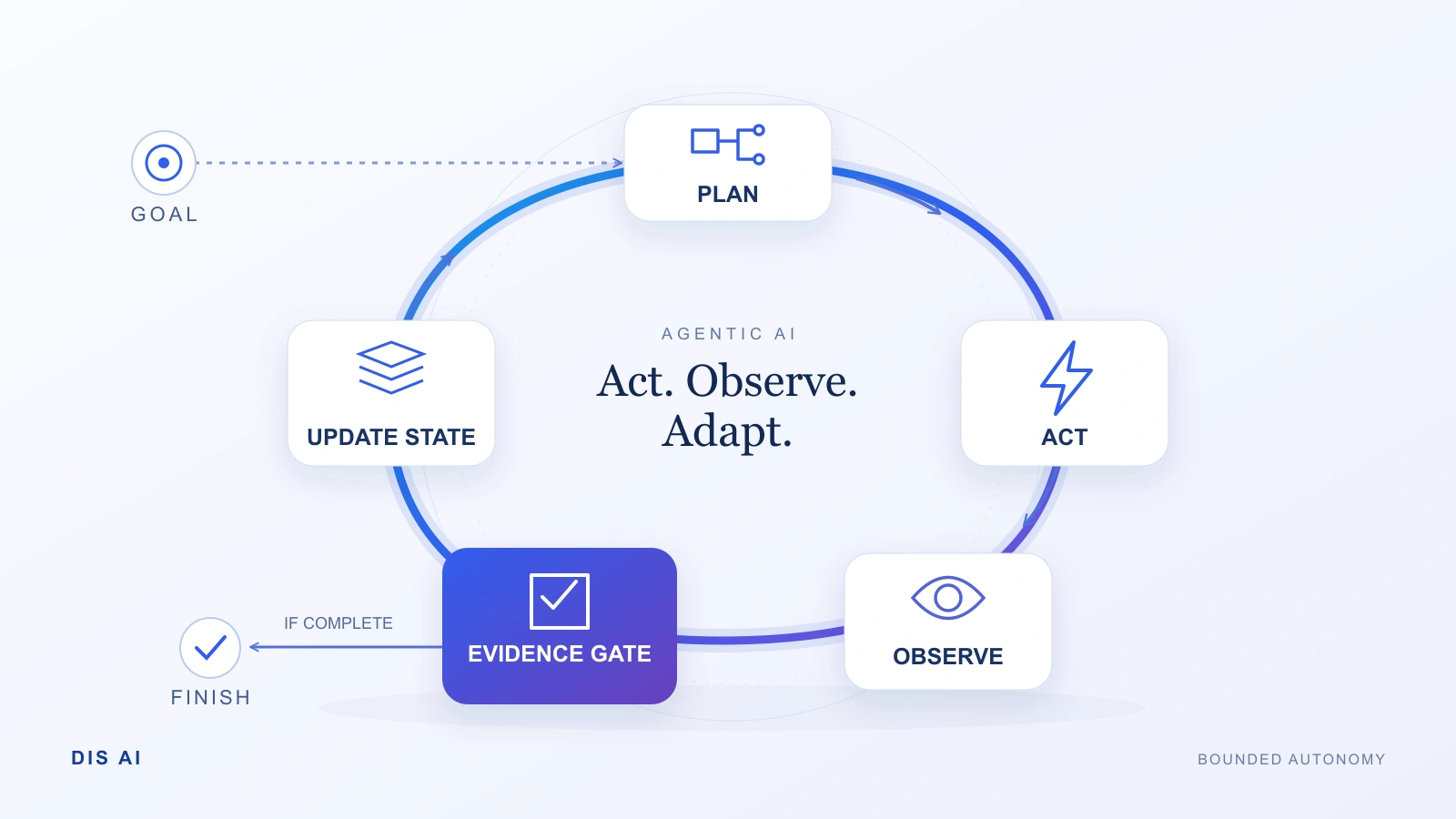
Goal → Plan → Act → Observe → Check evidence → Update state → Replan → Finish or escalateThe important difference is agency over a workflow. An agentic system can choose among tools, call APIs, search data, write or run code, delegate to other agents, check whether its work succeeded, recover from failures, and continue toward an objective.
From Answers to Actions
Suppose you give an AI system this task:
The goal
“Review this pull request and fix any bugs you find.”
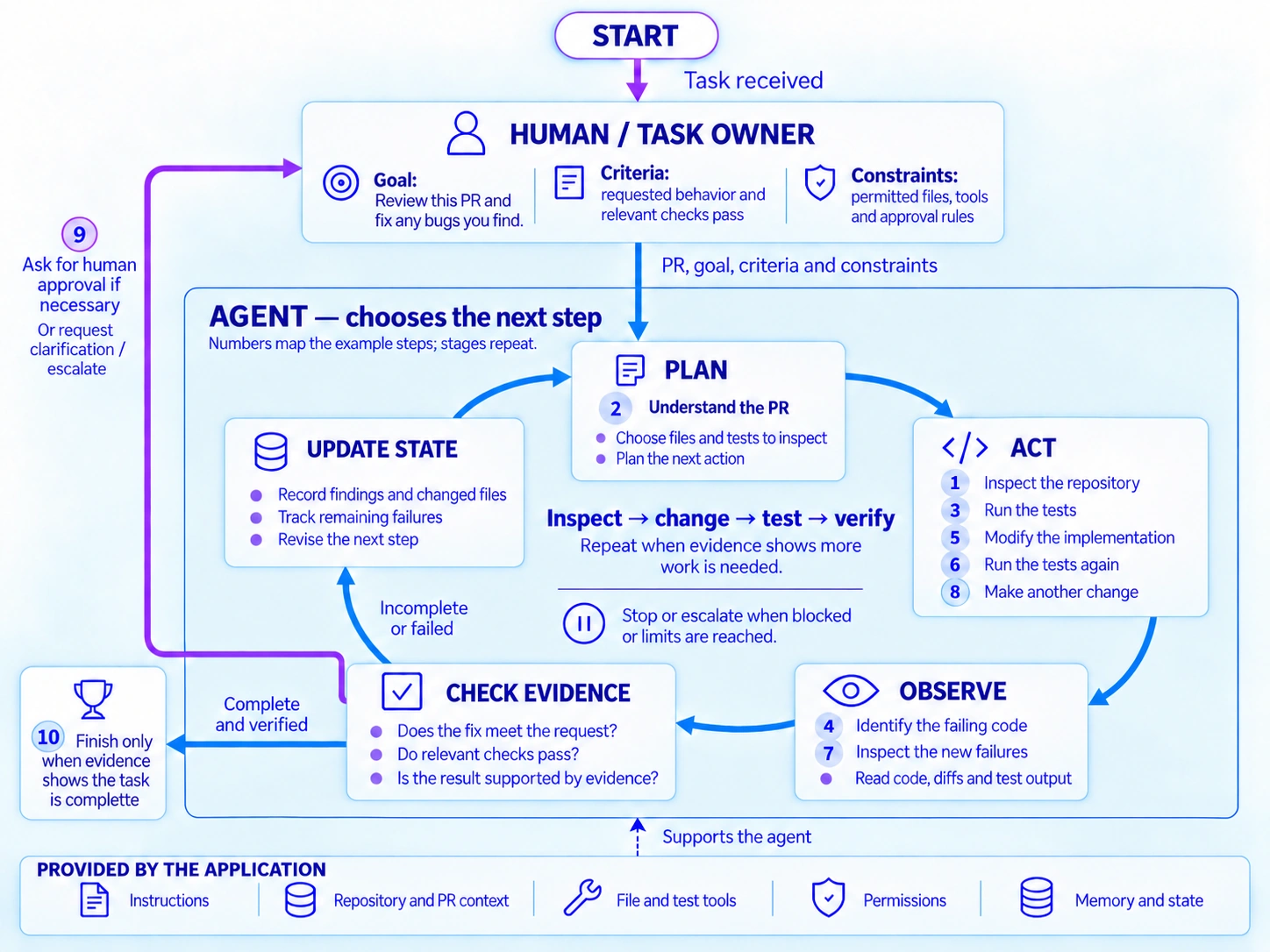
A normal LLM might read the code and suggest changes. With repository access and test tools, an agentic system might follow this path when it discovers a bug:
- Inspect the repository.
- Understand the PR.
- Run the tests.
- Identify the failing code.
- Modify the implementation.
- Run the tests again.
- Inspect the new failures.
- Make another change.
- Ask for human approval if necessary.
- Finish only when the evidence shows the task is complete.
This is an illustrative path, not a fixed script: the next step depends on what the system finds. That closed loop is one of the defining characteristics.
The numbered actions below map that example onto the loop. Several actions revisit the same stage.
Agentic doesn’t necessarily mean multi-agent. A single agent using tools and a feedback loop is agentic. A system such as Planner → Implementer → Reviewer is one way to organize the work, not the definition itself.
Who Decides the Next Step?
A useful way to distinguish an agent from a chatbot or workflow is to ask: who decides the next step?
- Chatbot: the user drives the sequence.
- Workflow: the developer predefines the sequence and decision rules.
- Agent: the AI can decide the sequence dynamically based on what happens.
These distinctions describe how the work is controlled, not how the interface looks. A chat interface can also be the front end to an agent.
Imagine the goal is: “Resolve this failed customer payment.”
A chatbot explains
A possible response
“Here are some possible reasons the payment failed.”
A workflow follows predefined logic
Check payment status → Check account → Send retry email → Create support ticketThat sequence is fixed in advance. A workflow can include conditional branches, but the developer still defines the available paths.
An agent adapts to the evidence
An illustrative operational sequence
“The payment failed. First I’ll inspect the transaction.
The decline code indicates insufficient funds, so retrying immediately won’t help.
I’ll check whether the customer has another payment method.
There is one. I need customer authorization before charging it, so I’ll send the appropriate request and wait.”
The path changes depending on the evidence. The agent can decide what to investigate next, but that does not give it permission to act outside its authorization.
What Makes a System Agentic?
In practice, look for these capabilities working together:
Goal-oriented behavior
It receives an objective rather than merely an instruction for one transformation.
Decision-making
It determines what action should happen next.
Tool use
It can interact with something outside the model: APIs, databases, browsers, code execution, email, files, or other agents.
State
It keeps track of what has happened during the task.
Observation
It sees the result of its actions.
Feedback loop
It can recognize, in effect, “That didn’t work; I need another approach.”
Stopping criteria
It determines when the objective has actually been achieved—or when it should stop and escalate.
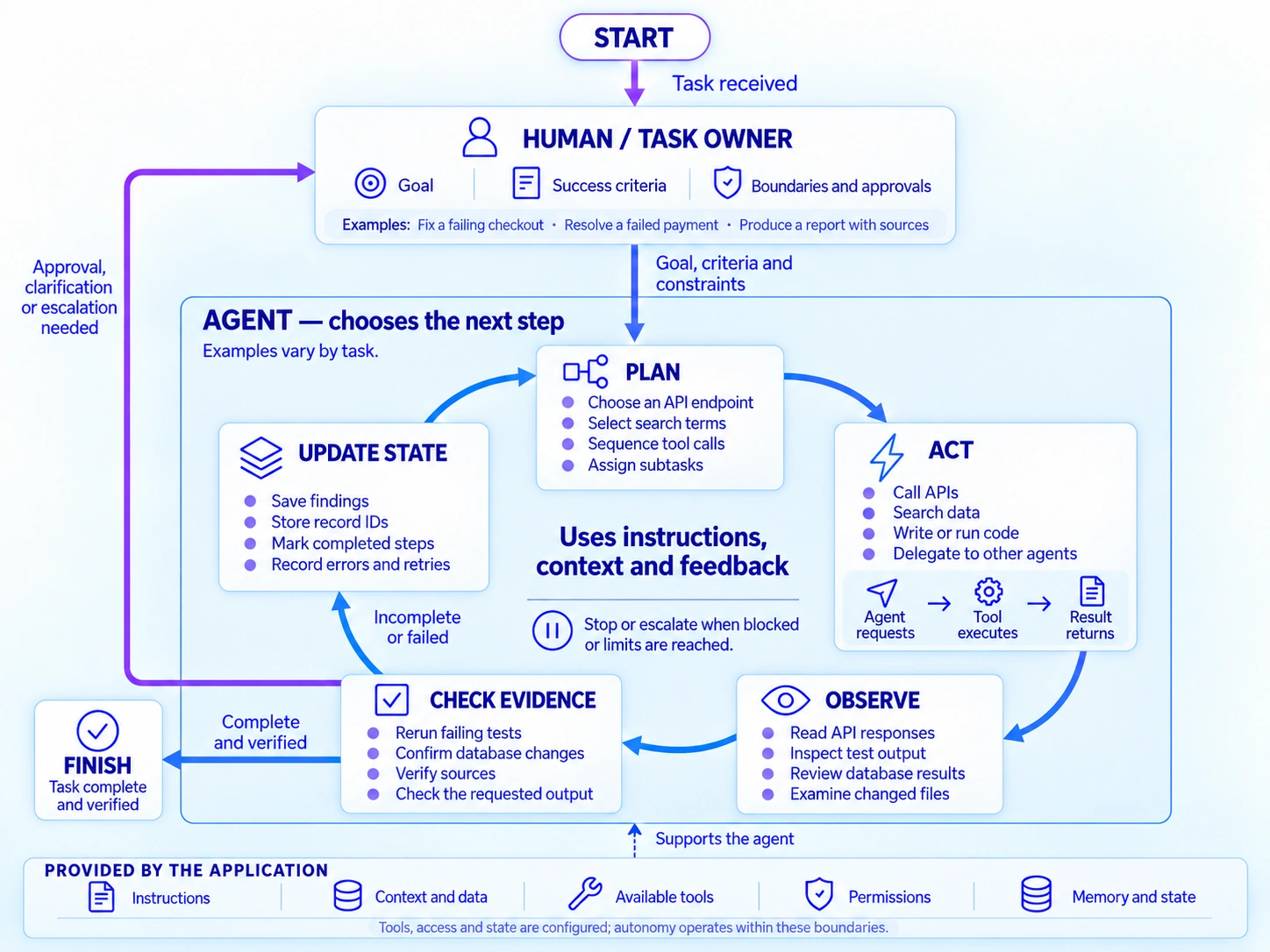
The capabilities form a loop: understand the current state, choose an action, use a tool, observe and evaluate the result, update state, and replan. Continue if the goal is not yet achieved; finish when the evidence supports completion, or escalate when it is not safe or possible to continue.
The application supplies instructions, context, tools, permissions, and memory. The agent uses those resources to choose its next action within the task’s constraints.
Where “Agent Washing” Happens
Many products call themselves agents when they are closer to this:
Prompt → LLM → API call → ResponseCalling an API does not automatically make an application agentic. Similarly, a sequence like this is often just an LLM-powered workflow if the steps are predetermined:
LLM → Step 1 → Step 2 → Step 3 → Step 4The important distinction isn’t whether an LLM is present. It is whether the system can choose and adapt its next actions based on intermediate results, rather than only follow predefined steps.
A workflow can still be the right design. A predictable process does not need open-ended decision-making simply to qualify for the “agent” label.
Different Patterns of Agentic Systems
“Agent” is not a completely binary category. It helps to distinguish several system patterns—but not treat them as a ladder where more agents automatically mean more intelligence or autonomy.
LLM application
One transformation
“Summarize this document.”
Tool-using assistant
A tool-supported request
“Search these documents and answer my question.”
Tool use alone does not establish whether the assistant controls an adaptive sequence.
AI workflow
Extract → Classify → Summarize → Create ticketAgent
Decide what needs to be investigated, select tools, act, evaluate, and retry when appropriate.
Multi-agent system
A planner coordinates a researcher, implementer, reviewer, or other specialized agents. This describes how responsibilities are distributed. The overall process may be tightly scripted or dynamically coordinated.
Long-running autonomous agent
Pursues a larger objective over many steps, maintains state, handles failures and changing conditions, and involves humans when appropriate. It may use a single agent or multiple agents.
Duration, number of agents, and degree of autonomy are different design choices. A single agent can have substantial autonomy; a multi-agent system can operate within a tightly constrained workflow.
Bounded Autonomy and the Evidence Gate
Production-grade agentic AI needs bounded autonomy: permissions, evidence checks, observability, evaluations, retry limits, human approval points, and safe escalation.
A practical architecture makes those responsibilities explicit:
- World stateUnderstand the goal and the current situation.
- PlannerChoose the next action within the allowed scope.
- ActionUse a tool or interact with the environment.
- ObservationCollect the result of the action.
- Evidence gateCheck what the result actually proves.
- State updateRecord the outcome, uncertainty, and remaining work.
Evidence, not assumptions
The evidence gate is especially important. Without it, many so-called agents are simply models repeatedly generating actions and assuming they worked.
In the pull-request example, changing the code is not proof that the bug is fixed. The agent needs to inspect test results and other relevant checks. In the payment example, sending an authorization request is not permission to charge another payment method.
The gate should ask whether an action succeeded, what remains unresolved, and whether the next step is allowed. A model’s own assertion of success is not enough.
Autonomy within explicit limits
Permissions define what the agent may access and change. Observability makes its actions inspectable. Evaluations test its behavior. Retry limits prevent endless loops, while approval points and escalation paths preserve human control over consequential decisions.
These controls turn a loop of model-generated actions into a system whose progress can be checked and whose authority remains bounded.
The shortest useful definition
Agentic AI is AI that can autonomously take a sequence of actions, use feedback from the environment, and adapt its plan to accomplish a goal.